

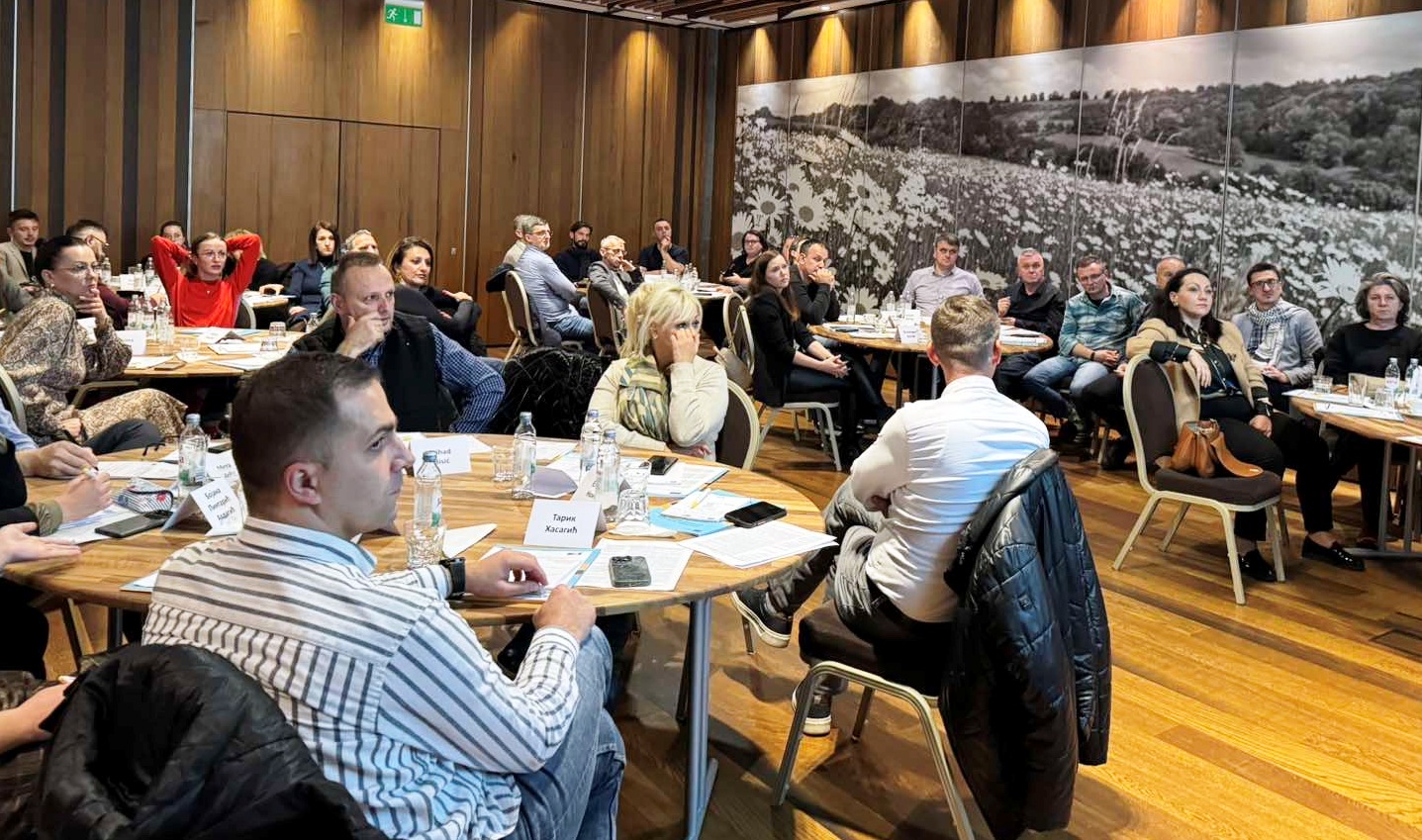
Organised by the EU for Vocational Education and Skills Recognition in BiH project, the training for future counsellors and assessors in the process of Validation of Non-Formal Education and Informal Learning (VNFIL) was successfully held on Jahorina in mid-November.
Using the previously developed methodological guide and handbook, the participants worked on deepening their knowledge and strengthening the competencies needed for the high-quality implementation of procedures for validating prior learning and skills.
The four-day training brought together over 90 participants — future trainers for the VNFIL model — representing educational institutions, vocational secondary schools, and employment services, all of whom play a key role in establishing, implementing, and sustaining this system in Bosnia and Herzegovina.
“This training is an opportunity for our school to become part of the VNFIL processes. We want to position ourselves better in the market of educational programmes and provide opportunities for adults who may have made different choices in their youth to correct those decisions and become more competitive in the labour market,” said Asmir Demir, training participant and Director of the Secondary School of Construction and Geodesy in Sarajevo.
“It would be important for us to contribute, at least partially, to solving the shortage of qualified workers in the construction sector,” he added.
The training programme is designed to build the capacities of the core group of 150 trainers — counsellors and assessors — who will play a central role in introducing the VNFIL system in BiH, plus an additional 30 practitioners.
This model of training also ensures long-term sustainability and enables the structured development of institutional and human capacities necessary for the operationalisation of the VNFIL system across BiH. The model is candidate-centred and aligned with the principles of transparency, inclusiveness, and compliance with EU standards and good practices in lifelong learning.
Through intensive discussions and exchange of experiences, participants on Jahorina strengthened connections and gained a deeper understanding of the VNFIL process from different perspectives.
“From the perspective of the Employment Service, this training was useful because the process is now moving a step forward — non-formal education and informal learning will be validated through an official type of certification within vocational schools. This will allow individuals to find employment more easily and more quickly,” said Tamara Jakupović, training participant and Head of the Centre Municipality Bureau of the Sarajevo Canton Employment Service.
“Our role as an Employment Service is to maintain employment levels, meaning that with the introduction of new technologies, workers are not dismissed but, through targeted interventions, upskilling and reskilling, remain in their workplaces and work with new tools,” she explained.
The establishment of the VNFIL model is an important step toward creating a fairer, more inclusive, and more effective system and labour market for all who have acquired skills and knowledge through non-formal pathways and continue to learn throughout their lives.
“What encourages me most is the strong cooperation established through the project between key education institutions, labour-market representatives and other partners. The jointly designed VNFIL system is something that will remain in place beyond the project’s duration because we all agree that this activity is not only project-based — it is essential and genuinely reform-oriented, opening new opportunities for people in Bosnia and Herzegovina,” emphasised Jasminka Marković, Senior Key Expert and Lead of the project component on VNFIL.
In the coming period, training for future VNFIL counsellors and assessors will also be held in Brčko, Tuzla and Bihać.
As part of the project’s continued activities, special attention will be devoted to piloting the VNFIL process in vocational schools in the Una-Sana Canton, Tuzla Canton, Sarajevo Canton and Brčko District. The pilot phase will demonstrate how well the system adapts to real-life needs and the local context.


